Why I replaced my starter with a generator
FindPlate v1 was a Next.js starter you clone and then delete from. v2 is a CLI that generates the repo and also sets up the board, rules, CI and previews around it. Why I made the switch, what went wrong, and what I haven't tested yet.
I have 15 case studies on this site. When I looked at the repos behind three of them, they had the same skeleton, which means I'd built it three times.
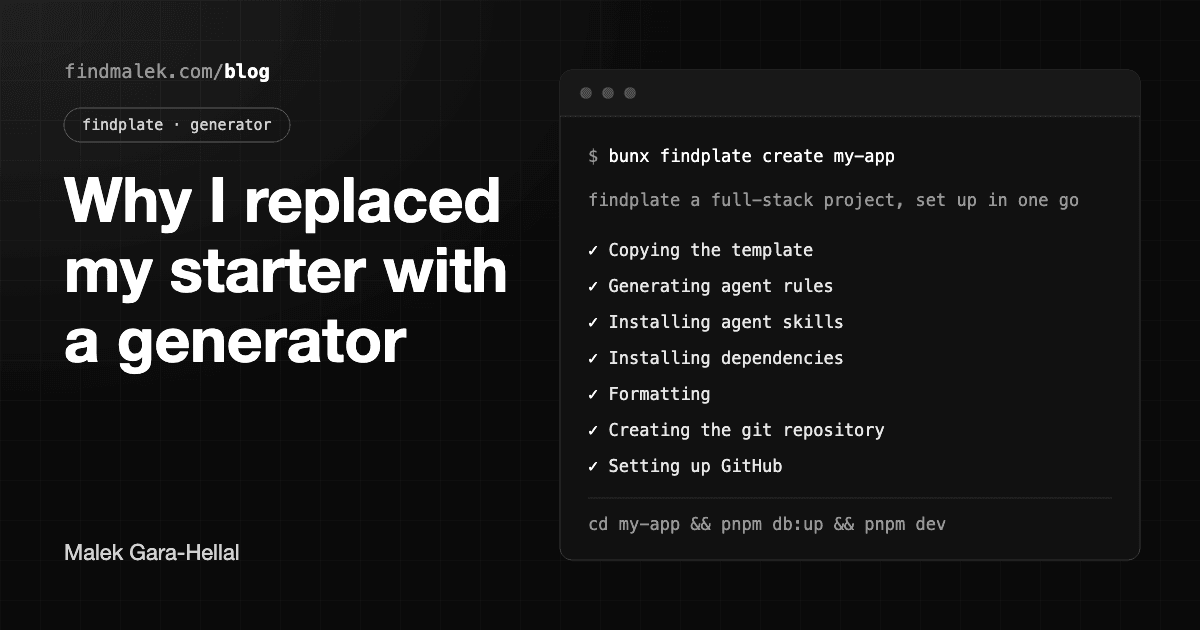
FindPlate is what I made so that day stops happening. You run bunx findplate create, and you get a turborepo with a landing page, a dashboard with login and an API. You also get the GitHub repo and board, the rules for your coding agents, CI and pull request previews, all from the same command.
One limit up front. findplate is not on npm yet. As I write this, npm view findplate returns a 404. The release workflow is there and I haven't pushed a version tag, so today it runs from a clone of the repo. I say more about what's untested near the end.
The same repo, again#
This is what I found when I looked at my own repos. I read apps and packages with ls in three of them, dukkani, sonaraem and lyterion, whose first commits are dated 2025-11-10, 2026-03-04 and 2026-10-12.
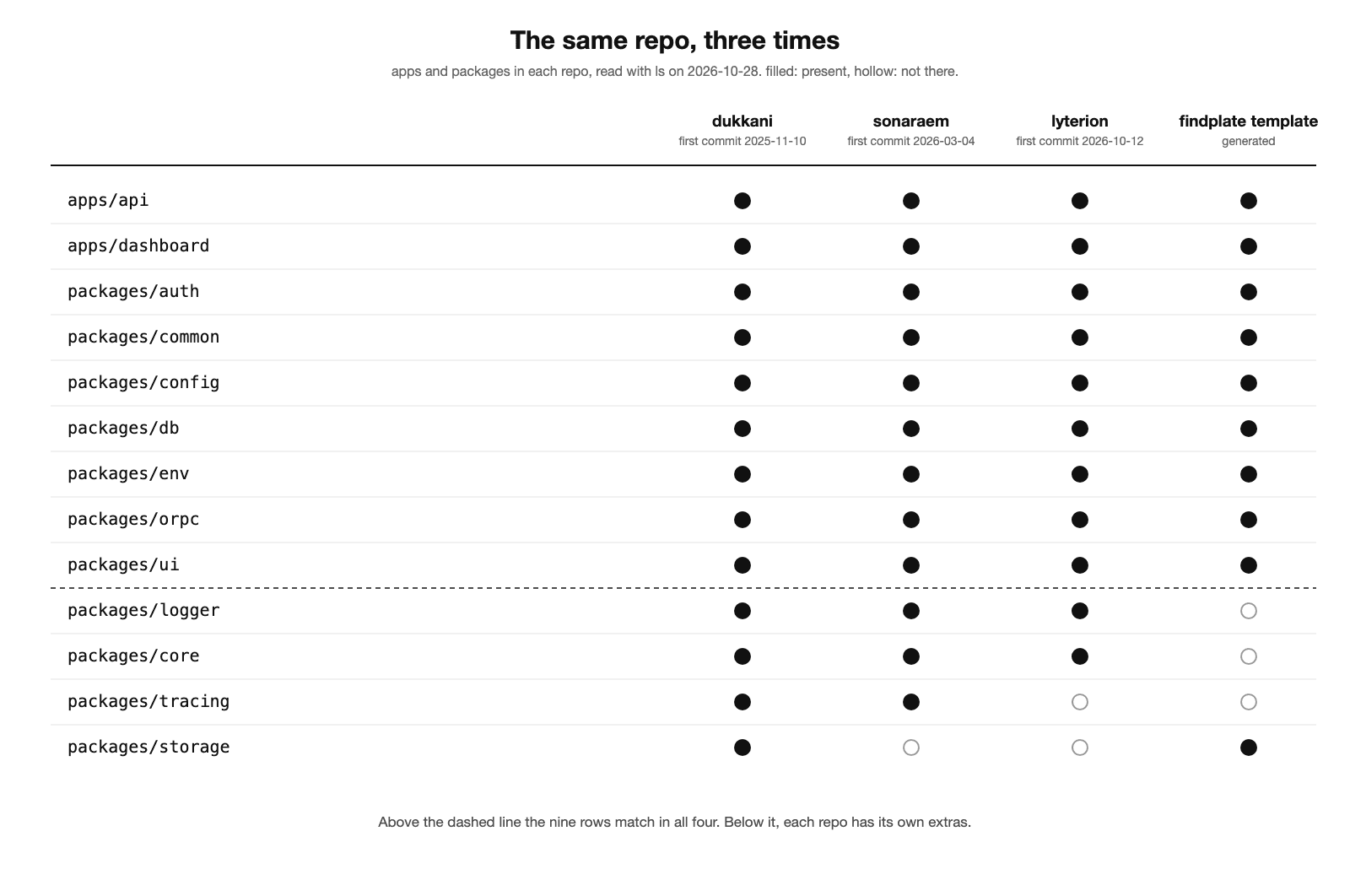
Each has an apps/api and an apps/dashboard, and the same seven packages: auth, common, config, db, env, orpc and ui. A pr-auto-assign.yml workflow sits in five of my repos. Nobody designed that. Each repo got the last one's setup, changed a little, because the last repo was the closest thing to a template I had.
That's the cost I wanted to remove. Not the hard part of a project, the part before it.
What v1 got wrong#
The first FindPlate was a Next.js starter. The v1 branch has 75 commits, from April 2024 to a React Server Components CVE fix in December 2025. It was one app with Next 14, Prisma, Supabase, next-intl, a waitlist form and a Nodemailer setup.
The problem with a starter is that you don't use it, you edit it. Clone it, rename the things, then delete what you don't need. The deleting is where the time goes. Every feature in it is one more thing to check before it's safe to remove, and the starter has no idea you did.
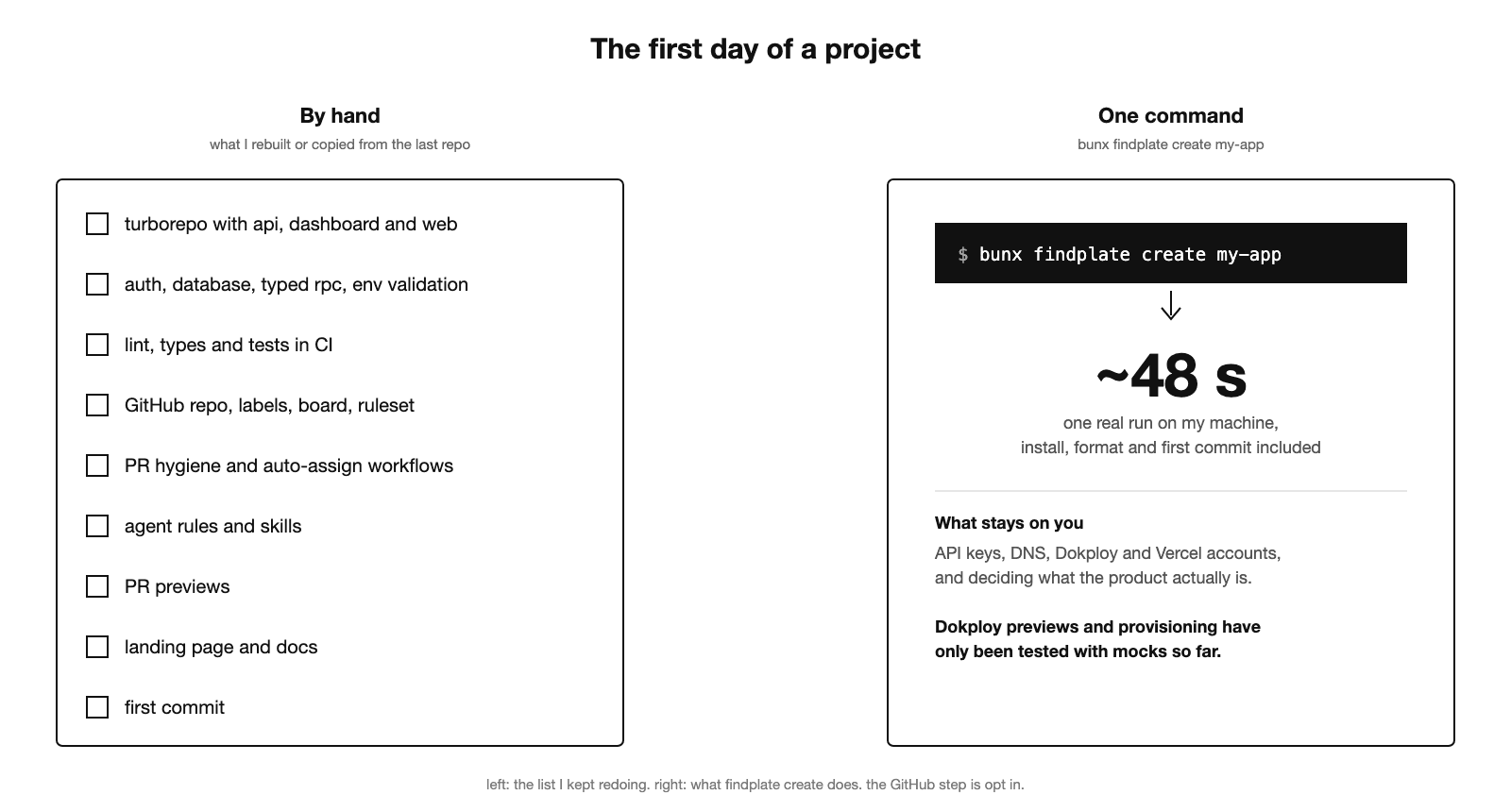
It also stopped at the code. The repo, the board, the labels, the CI rules, the agent instructions and the preview setup were all outside the template, and those were exactly the things I kept redoing by hand.
I wanted something simpler to say: after you run the command, everything is set up, even the readme, the GitHub project and the agent rules. That's why v2 starts at issue #3, "v2: cli and project template", and not at the template.
What I wrote down I wanted#
Before building it I listed what I wanted, in this order:
- a great and simple landing page
- docs, with fumadocs
- monochrome, boxed and minimal, like guesswork and keep-player
- customizable with shadcn create
- CI, tests and deploy, on Vercel or a self-hosted setup like Dokploy
- and the one above: best UX and DX, everything set up after the command
Almost all of this ended up in the repo. The look is the monochrome preset, which is the default. The docs and landing page live at plate.findmalek.engineer. Production is on Vercel, live at that address. Pull request previews are set up to run on the Dokploy server I host: the workflow and scripts exist, but they haven't run against it yet.
What I took from next-forge and create-t3-app#
I looked at two projects before starting: next-forge and create-t3-app.
From next-forge, the shape. A turborepo with several apps and shared packages, in a layout meant to be a real product and not a demo. I'd already been building that layout by hand, so seeing it in a template mostly confirmed it.
From create-t3-app, the interaction. A CLI that asks a few questions and writes the result, and that you can run without answers when you know what you want. Every prompt in findplate create has a flag, so -y plus flags never asks anything.
Where mine goes a different way:
- The generator does the setup around the code. The repo, labels, a project board with the columns Backlog, Ready, In progress, In review and Done, a ruleset on
main, PR workflows and previews. That's the part I wanted that I didn't find in either. - One choice per layer. One ORM (Drizzle), one auth library (better-auth), one rpc layer (oRPC), one linter (Biome). I didn't want a template with options I can't test. If you want Prisma or tRPC, FindPlate is the wrong tool, and the docs say so.
- Removal is a first-class feature. Optional modules disappear from the output instead of being hidden behind a flag.
The decisions that mattered#
One api that touches everything. In apps/api, bun runs oRPC, and it's the only app that talks to the database, auth, storage and providers. The landing page and the dashboard call it through the typed client. The one thing the dashboard imports from auth is the client, which calls back to the api. Dukkani and sonaraem already had an api app next to a dashboard, and this makes the split a rule you can state in one line: if you're in apps/web, you don't import the db package.
Markers, not a templating language. The template in template/ is a real project that's type-checked and tested in the repo. When a module is off, the generator removes lines between comment markers:
// @findplate:ai
import { createAi } from "@acme/ai"
// @end
A trailing // @findplate:ai marks a single line. The alternative was a template with {{#if ai}} holes in the source, which can't be linted or compiled until it's rendered. With markers, a broken template fails my own CI and not your first run. The price is that the stripper has to leave clean code behind, and I'll come back to what that cost.
One CI job per module. There are 17 modules, and CI generates each of them alone, all of them together and none, so 19 jobs. Each one runs lint, types and tests, and the all-modules and minimum jobs also run the build on pull requests. A matrix script reads template/findplate.json, so a new module needs no CI edit. A module that only works when another is switched on declares requires, and the matrix generates it with those.
A state file, so you can come back. create writes .findplate/state.json as it goes: your answers and each step that finished. If a run dies halfway, running it again skips what's done. The same file is why two more commands exist. findplate add ai regenerates the template with and without a module and applies only the difference, leaving files you edited alone. findplate update does a three-way merge against the template of the version you started from, with git merge-file, and writes conflict markers where you and the template touched the same lines.
The first plan was that a generated project would never talk to the generator again, and the docs' why page still says that. "Generate, then own it" is still true, and nothing imports findplate at runtime. But the plan meant a template fix could never reach a project that already exists, and add and update (#66, #67) landed after it.
What went wrong#
The history is mostly small fixes with an honest cause each, and I like those more than the features.
Stripping a module left code Biome rejects. Removing a marked block can leave a doubled blank line, or a blank line right after a bracket, and the formatter rejects both. A function called tidyBlankLines exists because of that. Markers inside an array literal were worse: in apps/api/src/server.ts the glitchtip and openobserve interceptors were marked entries of one array, so the output depended on which were on. bbcf387 turned it into an empty array plus one push line per module, each with its own marker.
Imports were out of order. Marked imports in the template weren't in Biome's order (@acme/whatsapp sat before @acme/telegram), so a generated project failed its own lint. Two commits called "sort imports" fixed that (2aa0799, 9da8ded), and step five of create runs pnpm check so the first commit doesn't hold code the project's own linter would change.
The state file dirtied the tree. add and update refuse to run on a dirty git tree, so you can always git restore .. But right after create, the tree was dirty: the git step was recorded as done after the first commit was made, so state.json changed after it. That was issue #59. The step is now recorded before git add -A, so the first commit contains the state that says it happened.
A duplicate key. The pnpm catalog in the template had @next/env listed twice at the same version. 6464828 removes the second one. It's one line, but several modules add their own catalog entries, which is how duplicates appear.
Spinners in a log. A spinner is nice in a terminal and noise in a CI log or an agent transcript. tasks.ts prints one plain line per step when stdout isn't a terminal (issue #61).
The first real GitHub run found two things the mocks couldn't. I ran findplate github against a private throwaway repo on my account (since deleted). It created the repo, labels, milestones, CODEOWNERS, issue and PR templates, workflows, 10 repo variables, 2 secrets and a project board with the Status columns. But the first run failed to push: the plan added an https remote, and my gh is set up for ssh with no https credentials. Issue #78 and PR #79, commit a646ae3: the remote url now follows gh config get git_protocol. The second finding was the ruleset on main, which failed with HTTP 403, "Upgrade to GitHub Pro or make this repository public", because rulesets need a paid plan on private repos. The step reports it and carries on.
Committing into someone else's repo. If you generate into a folder that's already inside a git repository, a git init and a first commit would commit the project into the outer repo. 68d284e skips the step with a note when the target already sits inside a repository.
What it doesn't do yet#
I haven't run some of the parts that talk to the outside world.
- Dokploy previews and
findplate provision. The preview workflow has only run against a mock server, and it skips itself when theDOKPLOY_*variables aren't set. The Dokploy projects, S3 buckets and DNS records are tested with mocks too. Some Dokploy API response shapes are assumed in the docs, and I kept them in one function so they're easy to correct. - Email, Telegram and WhatsApp. The Resend mailer test checks the request it would send. The Telegram bot and the Kapso WhatsApp module are tested the same way, with no real account behind them.
- The ruleset on
main. It has never run on a repo where it's allowed, since my one real run was on a private repo on a free plan.
What I did measure: one real create run took about 48 seconds on my machine, with agent rules, seven skill packs, install, format and the first commit. CI generates and checks the template 19 ways, and runs a migration drift check and Lighthouse on the generated landing page. That tells me the generated code is consistent, not that every integration works.
Some of my own docs lag behind the code too. A few pages still describe things as coming that already exist.
Who should use it#
Use it if you start full-stack TypeScript projects often, you're fine with Next.js, Drizzle, better-auth and oRPC, and you want the repo, board and CI in place before the first feature. Use it if you work with coding agents and want the same rules in every project.
Don't use it if you want a different stack, Prisma, tRPC or Auth.js, because I won't add them. Don't use it if you need payments, teams or billing, which I left out on purpose. And I wouldn't build a project you can't afford to debug on a tool whose Dokploy and provisioning steps have never met a real account.
The code is on GitHub, MIT licensed, with the long version of the build in the case study.